First the B196 extension, then a Yamaha XSR 125 — and eventually the realization that traveling abroad isn’t possible without a full motorcycle license. A personal account of how getting a license works in the digital age today — and what truly surprises you along the way.
It all started with the B196 extension — the option to ride light motorcycles up to 125 cc with an existing Class B (car) license after completing additional training, without having to obtain a full motorcycle license.
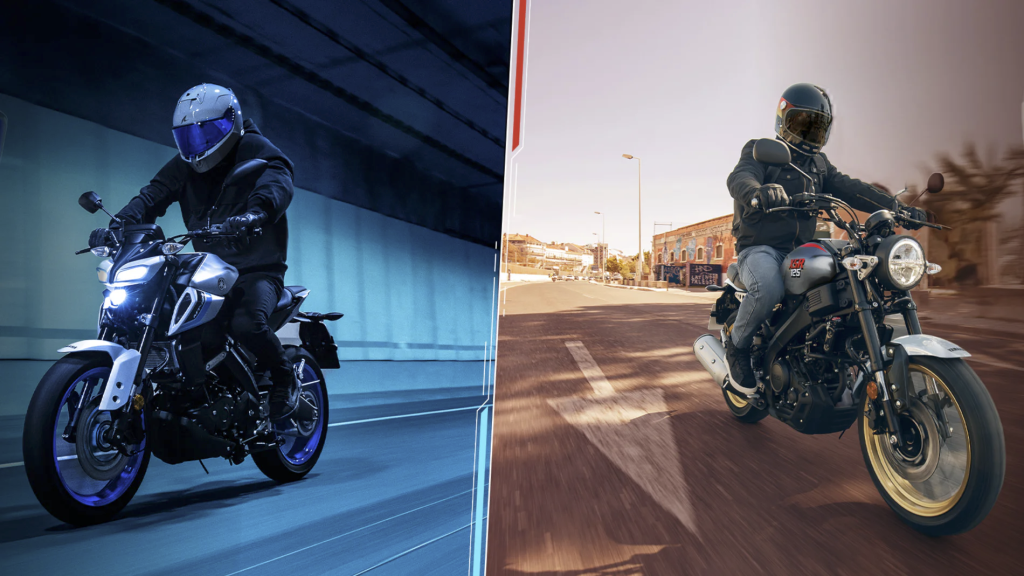
For some time now, I’ve been riding a Yamaha XSR 125, and motorcycling caught me from the very beginning — not because of speed or the urge to overtake others, but for exactly the opposite reason: the calm, attentive flow of it. Taking corners smoothly, arriving somewhere, enjoying the journey itself.
The issue only became apparent once my travel plans started to take shape. With the B196 extension, you’re allowed to ride light motorcycles within Germany — but abroad, very few countries recognize this Germany-specific regulation. Anyone wanting to cross borders on a motorcycle needs the real license: Class A. And that’s exactly what I’ll be working on this year.
What your existing Class B license already changes
Anyone who already holds a Class B license doesn’t have to start from scratch when upgrading to Class A. This has a direct impact on the scope of the theory test: instead of the 30 questions that new drivers without any prior license must answer, I only have to answer 20 — all of them taken exclusively from the motorcycle-specific section of the German Federal Motor Transport Authority’s question catalog.
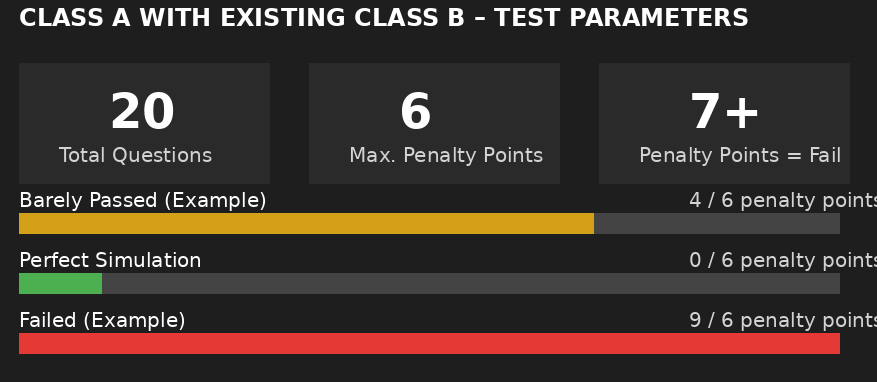
The limit is 6 penalty points — anyone who accumulates 7 or more has failed. Each question carries 2, 3, 4, or 5 points if answered incorrectly, depending on its severity.
At first, that sounds manageable, but there’s a catch: with only 20 questions, the margin for error is small. One incorrectly answered 5-point question and another worth 2 points — and you’re already at 7, which means you’ve failed.
The Digital Exam at TÜV: What to Expect
At the test center, you sit down at a touchscreen device. You present your ID, get assigned a seat, and begin. No paper forms, no pencils, no waiting for manual grading. All 20 questions appear one by one on the screen — including images, diagrams, and sometimes short video clips, for example showing hazardous traffic situations.
What stands out: the screen deliberately shows very little. No countdown, no progress bar, no distractions. The idea is to reduce pressure — and it actually works. The result appears immediately after the last question, with no waiting time. If you pass, you don’t receive a paper certificate anymore. Everything is handled digitally via TÜV Rheinland’s “StartDrive” portal:
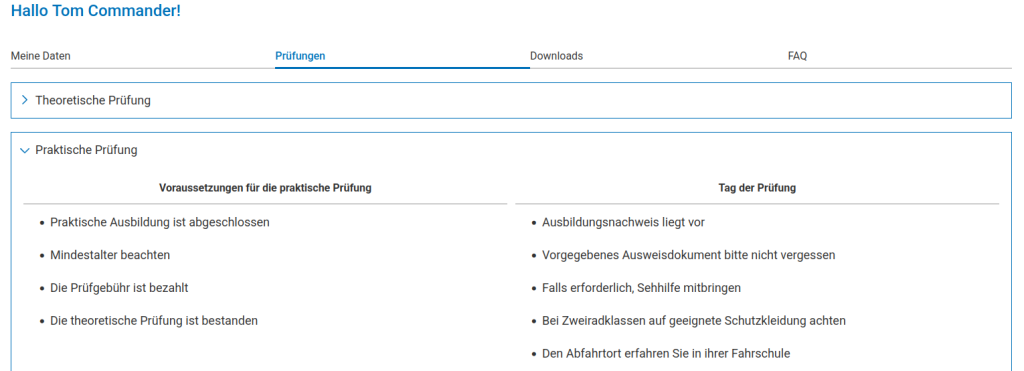
From the perspective of someone who works professionally with digital processes and their implementation, this is remarkably well executed: the question catalog is centrally managed by the German Federal Motor Transport Authority and updated uniformly across the country. This means that all test candidates in Germany are working with the same material — whether in Cologne, Dresden, or Munich. For a government-run system, that’s far from a given.
How the Digital Exam Works
Registration with a photo ID → automatic seat assignment → 20 questions on a touchscreen, with no time pressure per question → instant result after the final answer.
Once a question is completed, it cannot be changed. Upon request, the exam can be taken in more than 30 languages. Total time allowed for the exam: 45 minutes.
Getting There: Step by Step
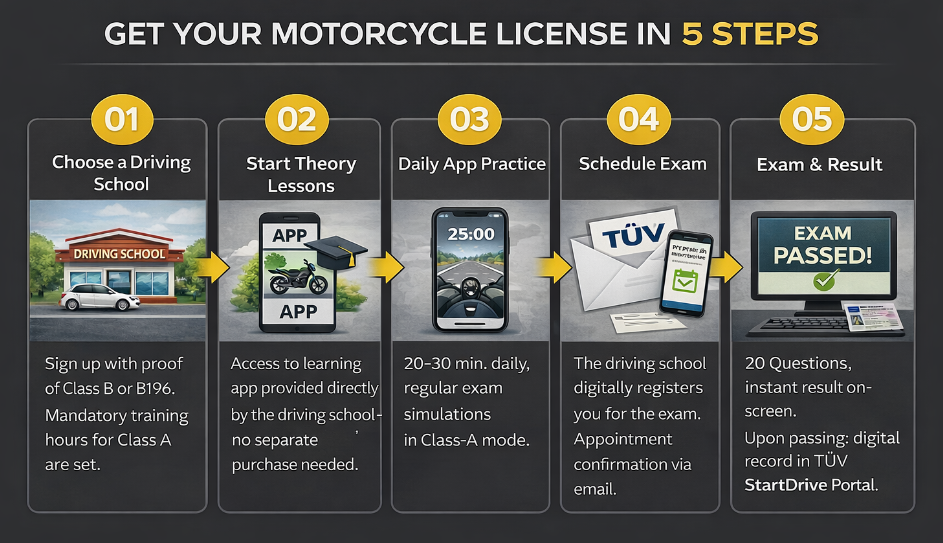
The Apps: What the Driving School Provides — and What I Tried in Addition
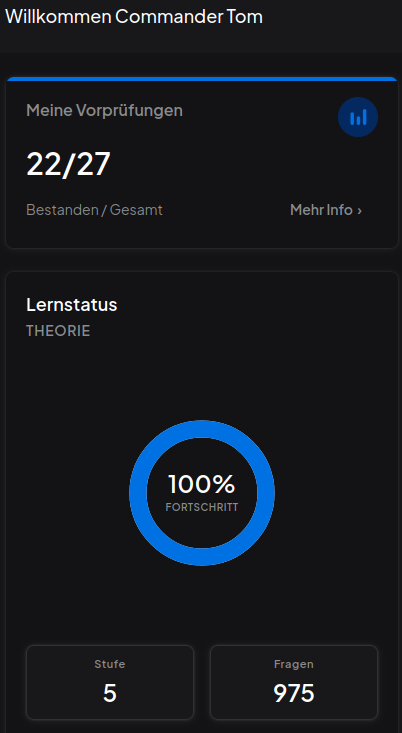
My driving school provided me with access to “Führerschein Live” right at registration — no extra charge, no separate app purchase required. That’s pretty standard practice by now: most driving schools have agreements with learning platforms and automatically give their students access. So there’s no need to buy or subscribe to anything — just sign up, enter the code, and start learning:
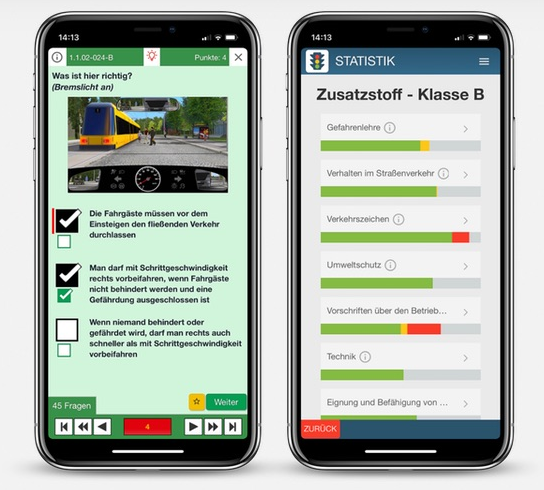
If you still want a second opinion, I also tried the app “Führerschein 2026 Pro” by Theorie24 GmbH, which also includes the official TÜV questions. It’s very well structured and a solid alternative for anyone who wants an additional perspective on the learning material:
Good to Know
Both apps are based on the same official question catalog from the German Federal Motor Transport Authority. The differences lie in structure, learning logic, and presentation — not in the content.
So if you’re comfortable with your driving school’s app, there’s no need for a second one. But if you’re unsure, using an additional app can be a helpful way to reinforce your learning.
What Really Surprises You When Learning
Anyone who has held a car license for years approaches motorcycle theory with a certain level of confidence. That’s understandable — but misleading. The questions in the catalog are often deliberately tricky. It’s not just about picking the “right” answer, but about carefully distinguishing between several options that all sound plausible. Two answers may look almost identical at first glance — and yet only one is correct.
The real challenge is this: the topics you think you already know are where most mistakes happen. Right-of-way rules are a good example. You’ve been driving for twenty years, you assume you’ve mastered them — and then you’re faced with a question showing an unfamiliar intersection layout, and suddenly you realize there’s a gap in your knowledge that has crept in over time.
This is exactly where the theory apps help. After each incorrect answer, they immediately provide an explanation, and through regular repetition, those gaps gradually close.
I thought I knew right-of-way rules in my sleep. Then came question number eight — and suddenly I wasn’t so sure anymore. It’s not the new topics that catch you off guard, but the old ones you’ve stopped consciously thinking about.
Personal experience, Class A learning phase
On top of that, there are the motorcycle-specific topics, which are genuinely different from anything you know from a car license: how a motorcycle behaves in corners, how braking distance and traction change on different surfaces, what standards apply to protective gear, and what that actually means in practice.
These topics aren’t necessarily more difficult than others — but they are new, and you can’t rely on existing knowledge.
My Learning Strategy for Class A
25 minutes a day in “Führerschein Live,” focusing exclusively on Class A mode. Every incorrectly answered question is immediately reviewed using the provided explanation — especially the ones I was actually confident about.
In parallel, occasional mock exams in “Führerschein 2026 Pro” serve as a cross-check. Only when both apps consistently show strong results do I consider myself ready for the theory test.
Conclusion: Well Designed — with a Small Gap
The digital driving test is, objectively speaking, a good example of how a bureaucratic process can noticeably improve through digitalization: standardized questions nationwide, instant results, no paperwork. The fact that driving schools provide access to learning apps right from the start makes the whole process even smoother.
What’s still missing: the step from passing the exam to actually receiving the license still runs through the local authorities — and that part isn’t fully digital yet. It’s the most noticeable gap in the system, but also an understandable one: driver’s license data is sensitive, and Germany’s administrative structure makes a fully digital process more complex than it sounds.
I’ve passed the theory exam successfully. Once the practical part is done, the XSR 125 can finally go where it’s been wanting to for a while — across the border, somewhere relaxed, unhurried, and just for the joy of the ride.