


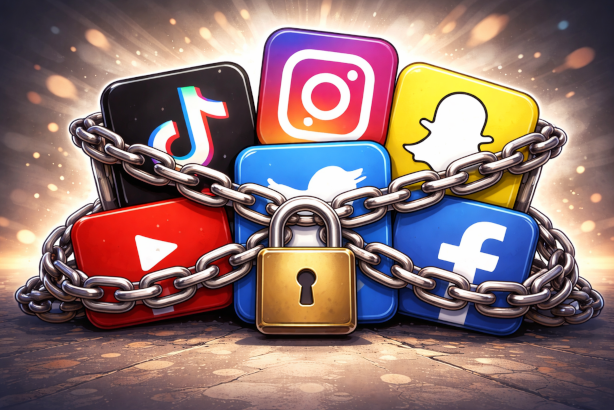
A social media ban for children is increasingly being debated in many countries. Supporters argue that it is a necessary step toward stronger online child protection. Critics warn, however, that such a ban would inevitably lead to stricter age verification systems and potentially a broader registration requirement on the internet, fundamentally altering how we access digital spaces.
But what would a social media ban for children actually mean in practice? And would it truly solve the problems associated with platforms like TikTok, Instagram, or Snapchat?
This article weighs the pros and cons — and ultimately argues that such a ban would be disproportionate and misguided.
What Does a Social Media Ban for Children Actually Entail? 🔎
A social media ban for children would require platforms to prevent minors from creating or maintaining accounts. To enforce such a ban effectively, companies would need reliable systems to verify users’ ages.
In practice, this would mean:
- 📇 Mandatory age verification
- 🪪 Digital identity checks
- 🔐 Storage of sensitive personal data
- 📋 Platform-wide registration requirements
In other words, a ban would be inseparable from stronger identity controls online.
And that is where the core problem begins.
The Arguments in Favor of a Social Media Ban ⚖️
Supporters raise several compelling concerns:
🧠 Mental Health Protection
Studies have linked heavy social media use to anxiety, depression, and distorted self-image among young people.
📉 Addictive Design & Algorithms
Platforms rely on engagement-driven algorithms and reward systems designed to maximize screen time.
👥 Cyberbullying
Unlike traditional bullying, online harassment does not end when the school day is over — it follows children home.
🔞 Exposure to Inappropriate Content
Despite age limits, minors frequently encounter harmful or age-inappropriate material.
These concerns are legitimate. The desire to strengthen child safety online is understandable.
Why a Ban Would Inevitably Require Registration ❗
An effective social media ban for children cannot rely on self-declared ages. Without meaningful age verification, the ban would be easily bypassed.
This leads directly to:
- Broader identity verification systems
- Increased data collection
- Reduced anonymity online
- A de facto registration requirement for digital participation
The internet would gradually shift from an open-access environment to a space where users must continuously prove who they are.
Today, age verification for social media.
Tomorrow, identity checks for forums, news platforms, or gaming communities?
The risk of expansion is not hypothetical — regulatory frameworks tend to grow once established.
Parental Responsibility Cannot Be Legislated 👨👩👧
Another critical issue: A social media ban for children shifts responsibility from families to the state.
In reality, parents who currently use tablets or smartphones to occupy their children will likely continue doing so. Instead of children’s accounts, they may simply use parental accounts.
The underlying issue does not disappear — it is merely redirected.
Laws cannot replace parenting.
Bans cannot replace digital literacy.
A Better Alternative: Education and School Policy 🎓
If the goal is genuine and sustainable online child protection, the focus should shift toward education.
📵 Smartphone Restrictions During School Hours
Clear rules can create focused learning environments.
🧠 Media Literacy as a Core Curriculum Component
Children should understand:
- How algorithms shape what they see
- How platforms monetize attention
- How manipulation and social pressure function online
💪 Building Digital Resilience
Strengthening self-confidence, critical thinking, and emotional regulation equips young people to navigate digital temptations more responsibly.
Long-term protection comes from competence — not prohibition.
Is a Social Media Ban for Children Proportionate? 🧭
Governments have a duty to protect minors. However, any intervention must be proportionate to its impact.
A social media ban for children would likely result in:
- Expanded identity verification mechanisms
- Structural changes to online anonymity
- Increased surveillance and data retention
- Easy circumvention via adult accounts
- A reduced role for parental accountability
The intervention would be deep and far-reaching, while its effectiveness remains uncertain.
Conclusion: A Social Media Ban Is the Wrong Tool
Yes, social media poses real risks.
Yes, platforms require stronger oversight.
Yes, children deserve protection.
But a social media ban for children, implemented through mandatory age verification and registration systems, represents a disproportionate response with significant side effects for digital freedom.
The more sustainable path lies in:
- 📚 Education
- 👨👩👧 Parental responsibility
- 🏫 Clear school policies
- 💪 Strengthening resilience
Protecting children should not come at the cost of transforming the open architecture of the internet into a fully identity-controlled environment.