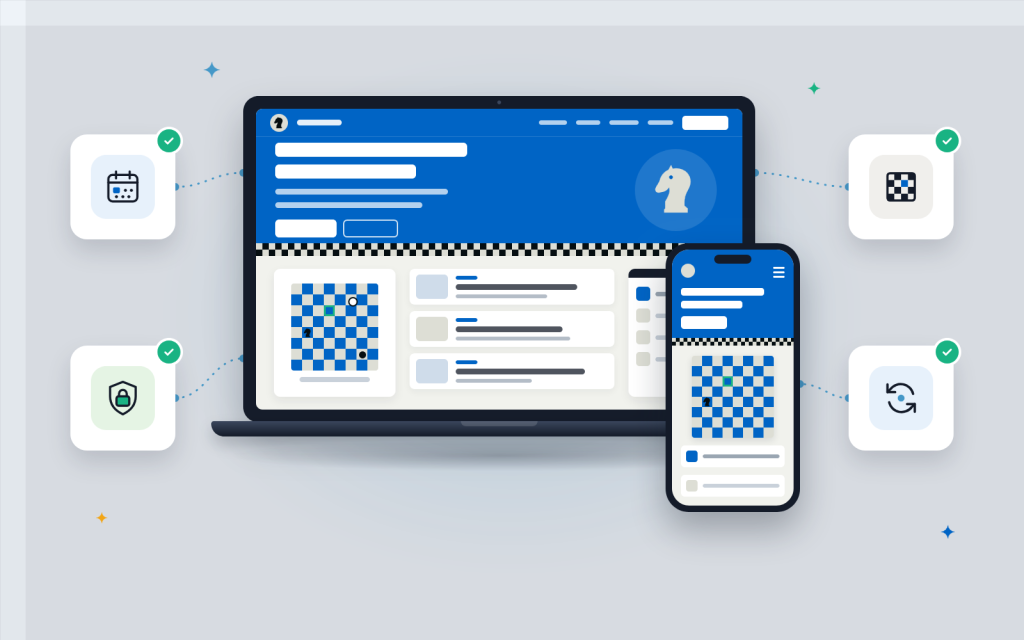
Many business websites were set up years ago and have been running in the background ever since. The content is still accurate, but the technology, the structure and the experience on a phone have stood still. Using a recent project, the website of the Bedburger Schachverein 1947 e.V. (Bedburg chess club), I show how you can modernise your website without making it more work to maintain. The principles behind it apply directly to business websites.
| At a glance | |
|---|---|
| Client | Bedburger Schachverein 1947 e.V., Bedburg (Rhein-Erft district, Germany) |
| Website | bedburger-schachverein.de |
| Period | October to November 2026 |
| Services | custom WordPress theme, new site structure, forms, data protection, hosting and updates |
| Technology | WordPress with a custom theme (no page builder), Contact Form 7 with Cloudflare Turnstile, cookie-free Rybbit analytics, Lichess, German Chess Federation interface |
Situation: Time for the next step
I had set up the club’s previous website myself, using a standard WordPress theme. It had been running reliably since 2020, and over the years more and more content was added: fixtures, results, the club history and the archive.
Over time, it became clear where a standard theme reaches its limits:
- As the content grew, so did the menu, to ten items by now.
- Fixtures and results were only available as PDFs. That is awkward on a phone, and search engines cannot find any text in some of the PDF tables.
- A standard theme knows nothing about chess: no board to replay games, no fixture list that updates itself.
The goals for the next step were clear: modern and tidy, in the existing colours and with the club logo, plus privacy-friendly visitor statistics. I see the same situation with business websites: the site works and the content is accurate, but it has grown over the years and the technology has not kept up.
Solution: A custom theme instead of a page builder
Instead of a page builder, I built a custom WordPress theme for the club. The colours come straight from the logo, the club keeps editing its content in the familiar editor, and the chess features run on their own in the background.
A design that comes from the logo
Club blue, the black of the pieces and the ivory of the light squares: I took these three colours from the logo. I cut out the logo itself so it sits cleanly on any background. As a recurring motif, a board edge made of two rows of chess squares separates the blue areas from the content.
The font is hosted directly on the website’s own server, so nothing is loaded from Google when a page opens.
A clear structure
The menu is now organised into three groups:
- What’s on? News, fixtures and youth
- Results: Championships, players and ratings, archive
- Visit us: Directions and becoming a member
Next to it sits a button for the club’s Signal group. If the screen is too narrow for one line, the site automatically switches to a menu button.
Key pages rebuilt
- Become a member: The page now leads in three steps from a trial visit to registration. Fees, statutes and bank details are clearly laid out alongside. The online application is protected against spam.
- Directions: Site plan, route planner and tips for car, train and bus on one page.
- Search engines: Every important page now has its own complete description for Google.
- Data protection: I added all new features to the privacy policy.
In short steps, in close contact
We worked in short rounds. Each request arrived as a small update that could be installed through the WordPress backend. That added up to more than 40 updates in less than two weeks. I tested every change on a test copy of the site first, on a computer and on a phone.
What the site can do now, and what applies to businesses
The site gained many features tailored to a chess club. More important than the individual features are the principles behind them, and those apply to every business website.
Enter it once, up to date everywhere
The club maintains its fixtures as a simple table in the editor. From that, the site automatically creates a fixture list by month, the next three dates on the home page, a “Club night today” notice and a calendar subscription for phones. It takes school holidays and public holidays into account by itself.
For your business: Opening hours, holiday closures, prices or events are often listed in several places and sooner or later contradict each other. It is better to have a single source from which the site generates everything else.
Data arrives on its own
The site fetches the ratings of all club players from the German Chess Federation once a day. It shows the club’s online tournaments directly from Lichess and even creates recurring tournaments there by itself.
For your business: Nobody has to retype what is already stored in another system. Customer reviews, appointments or the status of your services can be embedded directly. On my own website, for example, a live status shows whether my servers are reachable.
A reason to come back
Every day, a new chess puzzle waits on the home page for visitors to solve themselves. There are hints, a streak for everyone who solves daily, and a button to share the result via Signal or WhatsApp. The 1,447 puzzles come from Lichess’s freely licensed puzzle collection and last for more than three and a half years. On top of that there is a game of the week, training with 18 themes and a game database for replaying games.
For your business: People visit a site that never changes once. Short case studies, current tips or a small calculator give customers a reason to come back and recommend the site.
Forms that save work
Membership applications arrive complete and well organised by email. Members submit their games through a separate form. The games then wait for the press officer, who only has to approve them. Both forms are protected against spam.
For your business: A good enquiry form asks for exactly what you need to prepare a quote. That saves follow-up questions and keeps spam out.
Data protection from the start
The fonts are hosted on the site’s own server, and the map to the venue is only linked. The server fetches data from Lichess and the Chess Federation, so visitors do not connect to third-party services without noticing. The Rybbit visitor statistics work without cookies.
For your business: Every font, map or video loaded from a third-party server adds another item to the privacy policy and is often the reason for a cookie banner. If you plan for this from the start, you need fewer consents and a shorter privacy policy.
Result: A site with something new every day
The Bedburg chess club’s website is now tidy, easy to use on a phone and offers a reason to drop by every day. The club maintains its fixtures in a single place, and much of the rest updates itself.
- Less maintenance: A date is entered into the table once. It then appears on the fixtures page, on the home page, in the club night notice and in the calendar subscription. The rating list and the online tournaments run without any effort.
- Familiar workflow: All content stays in the normal WordPress editor. Nobody has to learn a page builder. Even the timeline of the club history is created automatically from the year headings.
- More for members and guests: Puzzles, training and games turn the site into a meeting point between club nights. For beginners and young players in particular, it is a good first point of contact.
- Run securely: The site runs on a server I look after. When a critical PHP security vulnerability became known in October 2026, the club’s site was up to date the same day.
- Measurable without cookies: The statistics show which pages and features are used, for example how often a puzzle is shared. That way the club sees what works.
What does this mean for your business website?
A completely new website is rarely necessary. Often a tidy design, a clear structure and reliable operation with regular updates are enough. Ask yourself:
- Are opening hours, prices or dates listed in several places, and not the same everywhere?
- Is your site awkward to use on a phone?
- Does nobody know exactly when WordPress and the plugins were last updated?
- Does your site load fonts, maps or videos from third-party servers?
- Has nothing changed on your site for months?
If you answer yes twice, it is worth taking a look at your site.
Conclusion: Modernising your website and save work
A modern website does not have to mean more work. It can take work off your hands. At the Bedburg chess club, the volunteers keep maintaining their texts and dates as usual, and the site does the rest by itself. The same principle works for any business website: maintain it once, run it securely, and your customers always find the latest information.
Would you like to modernise your business website or have it run securely? The initial consultation is free: Get in touch now
Transparency note: This article was written by me, Tom Commander. Its language was refined with the help of AI.